Crafting Historical Arguments from Historical Evidence:Throughout the year I learned how to address a question thru an argument. Like every year in AP World History, March Madness is the month were we start to debate with others about who is the better leader. Trying to learn this skill was challenging because you had to memorize a lot of information about your character and your opponent’s character. The objective of the debates is to review important historical people and why they were important. I believe that without the debates, I wouldn’t be able to remember who did what or why their actions were important. Figuring out who was a better leader was difficult because mostly every character had good actions and bad actions. It wasn’t about what they did but what did the character do to seem like a good ruler or person. For example, Darius the Great was a man that cared about his people and established a satrapy system. Within the empire there were various cultures because a lot of land was conquered, so Darius would pick a person from different places to rule the place they were from. This showed that he was a good leader because he wanted to satisfy his people but later on the Persian Wars began between the Persians and the Ionian Greeks because the Persians invaded the Ionian Greeks to try to make them part of their empire. Just because a war started doesn’t mean he was a bad leader, actually all he wanted to do was to expand his empire. I think that when there is a historical argument, it depends on how you interpret it with evidence. Evidence:Like i said before, in my debates, i was Darius I. He was king of the Persian Empire and brought the Persian Empire to its peek. I won my first debate against Saladin. It was very difficult because there was hardly anything bad about him, but i still managed to win. In my second debate, my opponent Alexander the Great defeated me. He was better at arguing that he was the better ruler and got the majority of the votes. 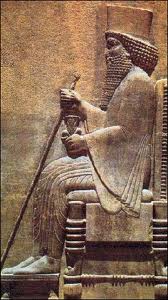 |
Chronological Reasoning:One of the skills that we had to learn throughout the year was to connect events and time periods. I believe this was the hardest skill to learn because it was difficult to keep up with all the major events with their time period. Something that has helped me this year was to learn the Chinese dynasty song. The Chinese dynasty song contains the Shang, Zhou, Qin, Han, Sui, Tang, Song, Yuan, Ming, Qing, The Republic, Mao and Deng. I learned this skill by writing notes on my Chinese dynast song paper and by coming to study sessions to connect major historical events. This song has helped me remember what happened and when did it happen. The way it helps is that just by looking at the historical background, you automatically remember what was happening, even though if you dint read a lot, there were at least something’s that you kind of remember. So this creates a chain reaction because once you remember something, another thing may pop up that was important also. This skill is very useful in essays like the change over time or the comparison essay. For example, I remember that Columbus discovered America in the year 1492, during the Ming dynasty (1368-1644). By remembering this I know that that year there was a lot of new food being introduced to other places and there was a spread of diseases with the Colombian exchange. I am glad I learned the Chinese dynasty song because without it, I would just be writing about events and putting them in the wrong time period. Evidence:In a study session, me and my classmates decided that we needed help in connecting events with the historical periods. So we made posters with parts of the Chinese dynasty song. This image contains the Sui, Tang, Song, Yuan and Ming (600-1450 CE). We also wrote down the regions like West Africa and East Africa. We wrote down the information that we know and connected the events. 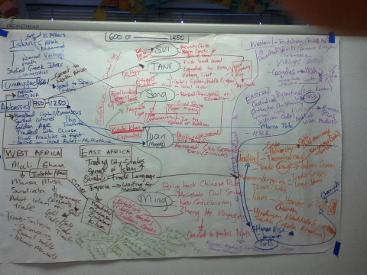 |
Comparison and Contextualization:One of the skills that I have learned is compare and evaluate multiple historical developments within one society or more. A method that I learned to compare societies is using a SPICE chart. SPICE stands for Social, Political, Interaction with the environment, Cultural and Economic. This means that I can compare two or more societies socially, politically, environmentally, culturally and economically. When you compare something social, you’re comparing the social classes, hierarchy and/or gender roles. For comparing something political, you’re comparing the form of government, law codes, and/or the authority to rule. When comparing something to do with the interaction with the environment, you compare the surroundings and/or the changing of the surroundings. You need to compare the writing, art, belief system and/or language when comparing something cultural. Also, trade, production of goods and/or agriculture is important when comparing something economic. When I would write my comparison essay, this spice chart was really useful. It made it easier for me to think of what I need to compare. Usually when I analyze two documents and I’m asked to compare them, I create a spice chart in my mind and immediately begin to write because I don’t want to waste time. I also used a spice chart when I began to plan my essay for my AP Exam and it helped me a lot. Even though we dint practice to make SPICE charts in class, I would practice by writing practice comparison essays. At the end of the year making SPICE charts just became natural because I got so used to doing them. Evidence:In this picture there is a SPICE chart that we had to do before we came into AP World History (summer packet). This was the first SPICE chart we had to do. We had to compare four societies which were the Tigris-Euphrates civilization, Egyptian civilization, Indus River Valley civilization and the Huang He (yellow) River Valley civilization.  |
Historical Interpretation and Synthesis:Lastly, another skill that I l learned this year is how to interpret historical sources of the past. This year we have been assigned homework multiple times to interpret historical documents and sometimes to compare them. We were taught that when we try to interpret historical documents, we use a chart called SOAPSTone. This stands for Speaker, Occasion, Audience, Subject and Tone. What it means by speaker it makes you analyze in what point of view is the document being told. Also what it means by tone is in what tone is the author speaking in. Analyzing the author’s point of view is important because if it’s talking about him and his enemy, then he is obviously going to say that he is better. This is being bias because we only know one side of the story. Here is where we think of an additional document that might be useful. I use SOAPSTone when I write my Document Based Question essays (DBQ). The SOAPSTone chart helps me group the documents faster and I can figure out the additional document. Usually by coming up with an additional document and grouping them I would earn about three or two points out of the seven I need to get. I think I did well on my DBQ when I took the AP exam because I tried my best to group the documents and I came up with a good additional document. I believe this was the easiest and most important skill to lean because I can use it in the future to interpret deeply a document. Evidence:This image demonstrates one of the SOAPSTone charts that we had to do for homework. We analyzed a document called "Self-rule is my birthright", "Africa for Africans" and a picture of a Banana named Carmen. I believe this was the first SOAPSTone chart were we had to analyze a picture for homework.  |
